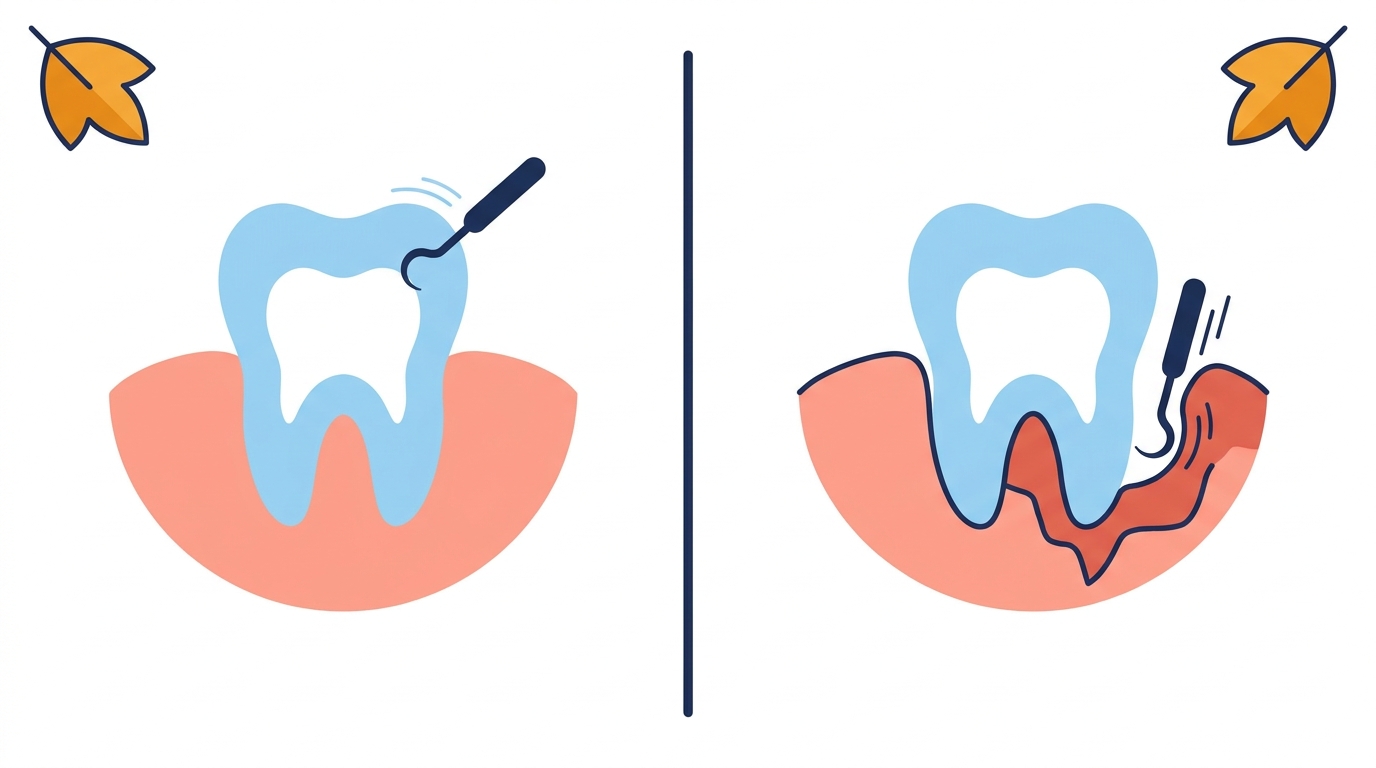
Here's the myth worth clearing up first: a "deep cleaning" is not just a more thorough version of your regular cleaning. Scaling and root planing (SRP) is a therapeutic treatment for diagnosed gum disease, while a routine prophylaxis is preventive care for healthy gums. They use different instruments, different codes, different time, and they answer different clinical problems — so if your Vineland, NJ dentist moved you from one to the other, it's a diagnosis change, not a sales pitch.
That distinction matters more than most patients realize. Periodontitis is widespread among adults, affecting a substantial portion of the population — including higher rates among older adults. Periodontitis is a significant cause of tooth loss in adults. So when a dentist recommends SRP instead of a routine cleaning, they're treating a disease — not upselling a spa service.
A routine cleaning — coded D1110 — is a preventive procedure for patients with a generally healthy periodontium or localized gingivitis. The hygienist removes plaque, calculus, and stains from tooth surfaces, mostly above the gumline and in shallow, healthy sulci. D1110 is the code for adult prophylaxis, used for preventive cleaning in patients with a generally healthy periodontium or localized gingivitis.
The key word is preventive. A routine cleaning controls irritants before they cause attachment loss. It does not, by design, reach deep below the gumline or treat diseased root surfaces. If pockets and bone loss are already present, a prophylaxis is not the right tool — not because it's cheap or shallow, but because it was never designed to treat active periodontitis.
Scaling and root planing is a therapeutic treatment for diagnosed periodontal disease. It cleans plaque and calculus from both the crown and the root surfaces below the gumline and smooths the affected roots so tissue can heal. The ADA uses two codes: D4341 for four or more teeth in a quadrant, and D4342 for one to three teeth in a quadrant.
SRP is quadrant-based for a reason. It targets specific areas of the mouth where disease has been measured and documented — not the whole mouth as a routine package. The ADA notes SRP may take more than one visit and may require local anesthetic, which is why it's often split across appointments. Insurance plans may request supporting documentation — such as a periodontal chart, X-rays, and a treatment plan — when SRP is submitted.
The decision rests on measurable findings, not preference. A periodontal evaluation includes pocket-depth probing, bleeding points, recession, mobility, and radiographs that show bone levels. The decision is based on measurable periodontal findings — such as pocketing with attachment loss and bone loss — that support a diagnosis of periodontitis.
At Vineland Dental, as at any ethical practice, the chart drives the recommendation. If your gums measure within healthy ranges, you get a prophylaxis. If probing shows pockets with attachment and bone loss, SRP is the appropriate starting point. There's also a middle code — D4346 — for generalized moderate or severe gingival inflammation, which the ADA distinguishes from both prophylaxis and SRP; it applies when periodontitis involving attachment and bone loss is not the diagnosis.
SRP is more involved than a routine cleaning, but it's a managed procedure — not a surgery. Because the hygienist or dentist is working below the gumline and on root surfaces, local anesthetic is commonly used so the appointment is comfortable. Some sensitivity or tenderness after SRP is normal and self-limiting.
That recovery window is normal and self-limiting. Soft foods, warm salt-water rinses, and gentle brushing usually carry you through. A follow-up evaluation a few weeks later checks how the tissue is responding, and depending on results, you may transition into periodontal maintenance — a distinct procedure from a standard prophylaxis, aimed at keeping stabilized disease from flaring back up.
Because gum disease is often silent until it's measured. Periodontitis is common among adults and much of it goes unnoticed because early periodontitis rarely hurts. A new set of measurements, an updated X-ray, or a change in bleeding points can shift your diagnosis from "healthy" to "periodontitis" between visits — and once that shift happens, the appropriate code shifts with it.
This is where the myth gets patients into trouble. Insisting on a routine cleaning when the chart shows periodontitis doesn't make the disease go away — and periodontitis cannot be reversed, only slowed and managed with professional treatment. A dentist who downgrades SRP to a prophylaxis to keep a patient happy is not doing them a favor; they're letting a treatable condition progress.
Ask to see your periodontal chart. Ask which teeth and which quadrants are involved, whether the recommended code is D4341 or D4342 per quadrant, how many visits are planned, and what reassessment follows. Ask whether radiographs and an exam are billed separately. A well-run office will walk you through the findings before any instrument touches a tooth — Vineland Dental, for example, states on its About page that treatment costs are communicated to patients before any work begins and that no patient leaves without understanding exactly what is happening and why.
For Spanish-speaking patients in the Vineland area, it also helps to know that Vineland Dental's team includes Spanish-speaking staff members Tania and Ashley, which makes walking through a periodontal diagnosis in a second language far less stressful. Vineland Dental has been part of the Vineland community for over 26 years and provides routine cleanings and exams along with gum disease treatment.
Yes — "deep cleaning" is the everyday name patients use for scaling and root planing, coded D4341 (four or more teeth per quadrant) or D4342 (one to three teeth per quadrant). It is a therapeutic treatment for diagnosed periodontitis, not a premium version of a routine cleaning. It reaches below the gumline and smooths affected root surfaces, which a standard prophylaxis does not do.
The answer lives in your periodontal chart. If probing shows pocket depths of 4mm or greater along with attachment loss and bone loss on X-rays, SRP is indicated. If your gums measure within healthy ranges and there's no radiographic bone loss, a routine prophylaxis (D1110) is appropriate. Ask your Vineland, NJ dentist to walk you through the chart before you agree to either procedure.
A regular cleaning cannot remove calculus or bacteria from deep pockets, so if periodontitis is present, a prophylaxis leaves the disease untreated and allows further attachment loss.
SRP is typically performed with local anesthetic so the appointment itself is comfortable. Soft foods and warm salt-water rinses help; most people return to normal eating and brushing within a few days.
The ADA notes SRP may take more than one visit to complete, and insurance plans typically expect it. Insurance plans may request supporting documentation — such as a periodontal chart, X-rays, and a treatment plan — when SRP is submitted, and splitting treatment across visits can also support patient comfort and anesthetic coverage. Splitting treatment also lets anesthetic coverage and patient comfort work in your favor.
Usually not — at least not right away. After SRP, your dentist reassesses the tissue and may place you on periodontal maintenance, which is a distinct procedure from a standard prophylaxis (D1110). Maintenance keeps stabilized disease from recurring. Periodontitis cannot be reversed but can be slowed and managed with ongoing professional treatment, which is what maintenance visits are designed to do.
If your dentist moved you from a routine cleaning to scaling and root planing, that's a diagnosis talking, not a sales script. Ask for the numbers behind it, understand which quadrants are involved, and confirm what follow-up looks like. Readers in Vineland, NJ who want a clear periodontal evaluation and a straightforward explanation of what their chart shows can reach Vineland Dental at (856) 205-9500 or visit https://vinelanddental.com to schedule a visit.